Use best AI models to destroy confusing research jargon
That's where AI tools like TLDRly enter the picture. They translate academic language into English, extract what actually matters, and spot numbers worth double-checking. For U.S. readers especially, they handle the small stuff—converting Celsius to Fahrenheit, flipping dates from European to American format, translating currencies.
AI works by analyzing patterns across entire documents at once. Using transformer architecture, these models see how concepts connect even when they're pages apart. But here's the catch: AI doesn't truly understand what it's reading. It gets the patterns right more often than not, but it can drop important qualifiers, oversimplify cautious language, or misread numbers. Which is why you always verify the summary against the original before trusting it.
TLDRly does three things well: it summarizes dense sections instantly, handles format conversions for U.S. audiences, and builds visual tools like mindmaps and checklists. The Chrome extension installs in seconds. Highlight a section. Get clarity. Move on.
Bottom line: AI summaries save serious time, but they're a starting point, not a substitute for reading. Verify the numbers. Check the claims. Then use what you've learned to make better decisions faster.
How to summarize research articles and papers using AI
How AI Models Process Research Text
AI models break dense text into digestible pieces using what's called transformer architecture. Instead of reading words one at a time, these systems analyze how terms connect across an entire document. A phrase buried on page five—say, "heterogeneous catalytic processes"—gets linked to "reaction efficiency" mentioned three pages earlier, even if the connection isn't explicit. That pattern recognition is powerful.
But pattern recognition isn't understanding. The AI doesn't actually know what heterogeneous catalysis is. It knows what text about it tends to look like. Which means subtle qualifiers sometimes vanish. A cautious "suggests" becomes a definitive statement. A conditional "may increase by up to 45%" gets flattened to "45% increase."
Strengths and Limitations of AI in Research Summaries
AI excels at condensing. A three-paragraph methodology? Compress it to two sentences without losing the key steps. AI also spots important findings even when buried in dense discussion sections. And it translates jargon reliably—turning "statistically significant correlation between variables X and Y" into "strong connection between X and Y"—which is often exactly what non-experts need.
The real problems emerge with nuance. AI oversimplifies cautious language. It stumbles with mathematical formulas and statistical context. If a study says "45% improvement under optimal conditions" but only tests two subjects, the AI might pull "45% improvement" and miss the part that makes it almost meaningless. And brand-new research? Concepts that emerged after the AI's training data cuts off? The model guesses, sometimes confidently.
This is non-negotiable: always cross-check key numbers, dates, and claims against the original source. If the summary says "1,500 participants," find that exact number in the methodology. If it claims a 45% efficiency increase, verify whether the paper actually said "up to 45%" or "45% in one specific scenario." These distinctions matter for real decisions.
Adjusting AI Outputs for U.S. Formats
AI trains on global research, so outputs stay in whatever format the original used. Celsius. Kilometers. European date formats. DD/MM/YYYY. You'll need to flip these for U.S. context:
- 100°C becomes 212°F. 1 kilometer becomes 0.62 miles. The number "1.000.000" becomes "1,000,000."
- Dates flip from DD/MM/YYYY to MM/DD/YYYY.
- Foreign currencies convert to USD using current rates.
TLDRly handles some of these conversions automatically, but don't trust it blindly. For professional work—policy briefs, grant applications, clinical decisions—verify every unit conversion, every decimal, every currency. A misplaced decimal point in a dosage, a swapped unit in an engineering spec, a botched currency conversion in a budget projection—these aren't small errors. They're decision-killers.
Setting Up TLDRly for Research Tasks
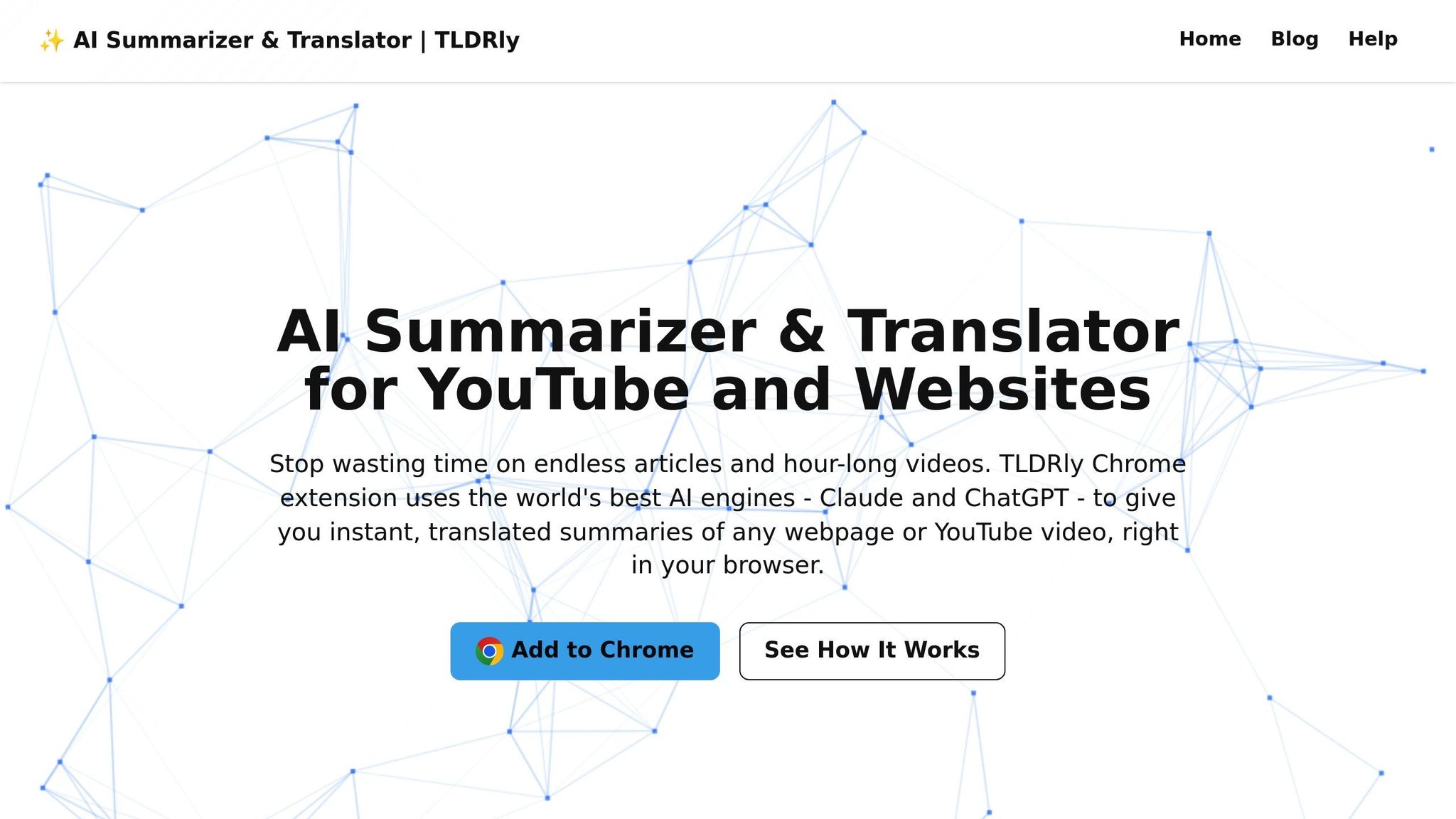
TLDRly lives in your browser and works where you already read research. No clunky uploads. No jumping between tabs and separate tools.
Installing the TLDRly Chrome Extension
Go to the Chrome Web Store, search "TLDRly," and hit Add to Chrome. Confirm the permissions prompt. If the icon doesn't show in your toolbar immediately, click the puzzle icon and pin it.
First use requires account setup—just sign in or create one. This syncs your preferences across devices. Done.
Using TLDRly on Academic Papers and Technical Documents
Open any research document. Click the TLDRly icon. Highlight the section you want simplified—methodology, results, a particularly dense paragraph. TLDRly processes the context and delivers plain-language output tailored to what you actually selected.
Converting Complex Research into Plain Language
Research buries insights under layers of academic phrasing. TLDRly surfaces them.
Creating Simple Summaries
Highlight dense text. Click TLDRly. Get a rewrite. "Multivariate regression analysis demonstrated statistically significant correlations" becomes "the study found strong connections between the tested variables."
You can adjust the reading level too—high school, professional, general public. This matters when you're preparing summaries for different audiences. TLDRly adapts without losing precision.
Summarizing Specific Sections
Research papers follow predictable structure: introduction, methodology, results, discussion. Don't summarize the whole thing if you only care about methods. Highlight the methodology section. Get clarity on what researchers actually did. Skip the irrelevant parts. Same for results or discussion. Targeted summaries beat full summaries when you're on deadline.
sbb-itb-b6b147d
Using Visual Tools to Understand Research Better
Numbers and text alone don't always reveal relationships. TLDRly generates visuals that make structure visible.
Building Mindmaps from Research Papers
A mindmap lays out the central question, methodology, findings, and conclusions in one view. You see how ideas connect without wading through paragraphs. It's especially useful when you need to brief others quickly or remember the study's architecture weeks later.
Creating Step-by-Step Checklists
TLDRly converts methodologies into numbered steps. Useful for presentations, for following procedures yourself, or for explaining what researchers did without needing to cite the paper directly. Break it into five steps. Much easier to share than a dense methods section.
Checking and Improving AI-Generated Content
Don't trust AI summaries alone. Verify. Refine. Repeat.
Verifying Key Facts and Numbers
Open the original document alongside the TLDRly summary. Find every percentage, dollar amount, sample size, and measurement unit. If TLDRly says "1,500 participants," locate that exact figure in the original methodology.
Tables and charts confuse AI. Numbers get transposed. Unit conversions go sideways. Check these twice. Even minor errors—a dropped decimal, a unit mix-up—can wreck the meaning of scientific data.
Refining Text with TLDRly
After verification, use TLDRly to polish language. Rephrase overly technical sections while keeping them accurate. "The intervention demonstrated statistically significant improvements in cognitive performance metrics" could become "the treatment measurably improved test scores." Make it accessible without losing precision.
You can also adjust detail levels—expand critical findings by adding context from the original, or cut less important sections to focus on takeaways. Polish it. Then move to the next step.
Identifying Research Limitations
Every study has constraints. Small sample sizes. Potential biases. Findings that might not generalize. Understanding these limits shapes how you interpret results and decide when to apply them.
Look for the "Limitations" section near the paper's end. Ask TLDRly to summarize it. Flag sample diversity gaps, short study durations, self-reported data, whatever constrains the findings. This clarifies what the research actually proves versus what it merely suggests.
Also have TLDRly identify language strength differences. "Statistically significant" is rock-solid. "Suggestive" or "preliminary"? Weaker. The AI can flag this language, but your judgment matters. A critical evaluation of research reveals which insights are meaningful and which are speculation.
Don't outsource this thinking to the AI. Your skepticism is the difference between understanding research and being fooled by it.
Conclusion
Complicated jargon costs time and buries insights. TLDRly transforms dense papers into clear summaries you can actually use. Built on advanced AI models, it simplifies language without sacrificing accuracy, helping you process research faster.
It lives in your browser. It converts measurements to imperial, dates to MM/DD/YYYY, currencies to dollars—automatically adjusting for U.S. audiences. You extract specific sections, tweak summaries, spot limitations at a glance.
Research shows AI-simplified content actually improves understanding. Readers of AI-generated summaries grasp scientific concepts more effectively and produce more accurate takeaways than those wrestling with original academic text [1]. By making information digestible, TLDRly lets you verify details while keeping the science intact.
The real win is speed plus clarity. Less time deciphering jargon. More time acting on what you've learned. Whether you're reviewing clinical trials, engineering reports, or policy papers, TLDRly cuts friction from your workflow. Extract what matters. Verify the numbers. Make better decisions. That's it.
FAQs
TLDRly uses advanced algorithms trained on diverse datasets, letting it handle complex material and technical jargon effectively. The platform applies quality control consistently and improves its models over time. It prioritizes both clarity and accuracy—simplified insights that stay true to the original research.
That said, bleeding-edge research sometimes falls outside its training data. Emerging concepts can trip up the AI. Always verify summaries against the source before treating them as fact.
Think of TLDRly as a powerful shortcut, not a substitute for verification. For professional work, double-check key facts and insights against reliable sources. The tool excels at breaking down complex content, but confirming essential details ensures dependability.
Make verification part of your workflow: use TLDRly to save time understanding the paper, then cross-check claims before acting on them. Efficiency plus accuracy. That's the balance.
TLDRly automatically converts international formats to U.S. standards: currencies to USD, measurements to imperial, dates to MM/DD/YYYY, spelling to American English. Most conversions are seamless.
Rare or highly specific formats occasionally need manual adjustment. For the vast majority of users, it simplifies localization and saves time. Just don't assume every conversion is perfect—spot-check critical figures.