Cross-Lingual Summarization: How It Works
You're reading a crucial research paper. It's in German. Your German is... nonexistent.
Cross-lingual summarization solves this by creating summaries in your language from content written in another. Not translate-then-summarize. Not summarize-then-translate. A single unified process that actually understands both sides of the equation.
Here's why this matters: the old approach—running text through Google Translate, then summarizing the mangled output—loses context at every handoff. Cross-lingual models skip the middleman entirely.
The quick version:
- Modern systems use GPT-4, Claude, and mBERT to handle this in one pass
- Two legacy approaches exist: Summarize-then-Translate (shorter text but context bleeds out) and Translate-then-Summarize (preserves meaning but computationally expensive)
- Direct multilingual models now outperform both pipelines
- The hard problems: preserving meaning across cultural contexts, handling idioms that don't translate, and supporting languages with limited training data
- Tools like TLDRly make this practical—instant multilingual summaries for articles, videos, and webpages
This tech is already transforming business intelligence, news distribution, academic research, and legal document processing.
The AI Models Doing the Heavy Lifting
What's Actually Running Under the Hood
Cross-lingual summarization requires models that can think in multiple languages simultaneously. The current workhorses fall into a few categories.
Large language models like GPT-4 and PaLM 2 handle this through instruction-following. Give them a French article and ask for an English summary, and they produce one directly—no intermediate steps[2]. The key insight: these models don't translate then summarize. They've internalized enough multilingual knowledge to compress and convert in a single forward pass.
Multilingual BERT (mBERT) takes a different approach. Trained on 104 languages simultaneously, it builds shared representations that let it align semantic meaning across language boundaries[2][4][7]. Think of it as a universal semantic space where concepts cluster together regardless of the language expressing them.
M2M-100 solves a specific pain point: most translation systems route everything through English. Japanese to Portuguese? Japanese → English → Portuguese. M2M-100 translates directly between any of its 100 supported languages[2][4][7]. This matters because every routing step introduces drift.
The SumTra system (2024) represents the state of the art in few-shot scenarios. It chains a pretrained English summarizer with a multilingual translator in a differentiable pipeline—meaning errors can backpropagate through the entire system for end-to-end optimization[2]. Tools like TLDRly leverage similar architectures to deliver this capability directly in your browser.
Extractive vs. Abstractive: Pick Your Trade-off
Two fundamentally different approaches exist here.
Extractive summarization pulls exact phrases from the source text. It's safe—you can't hallucinate if you're only selecting existing sentences. But the output often reads like a patchwork quilt, especially when those sentences were written in a different language and translated.
Abstractive summarization generates entirely new sentences. The results flow naturally in the target language because the model writes them from scratch. The risk? The model might subtly distort meaning or introduce information that wasn't in the original[4][5].
For cross-lingual work, abstractive methods generally win. A German sentence structure forced into English reads awkwardly. Abstractive models regenerate the content in natural English from the start. Recent advances in neural architectures have made these systems reliable enough for production use.
The Three Pillars: NLP, Transfer Learning, Semantic Alignment
Three concepts make cross-lingual summarization possible:
Natural Language Processing (NLP) provides the parsing, understanding, and generation capabilities. It's how models identify key concepts, parse syntactic relationships, and produce coherent output[4][7].
Transfer Learning lets models leverage English training data (abundant) to perform well on Swahili (scarce). The model learns general language patterns from high-resource languages, then adapts to low-resource ones[4][7].
Semantic Alignment ensures concepts map correctly across languages. The German word "Schadenfreude" doesn't translate directly to English—alignment techniques ensure the underlying concept (pleasure derived from another's misfortune) carries through[4][7][8].
Modern systems enforce alignment through joint training on parallel corpora, contrastive learning to push similar concepts together in embedding space, and discriminators that flag semantic drift during generation.
Can A Summarizer Handle Different Languages? - The Language Library
The Four Methods (and When to Use Each)
Two-Step Pipelines: The Legacy Approaches
The traditional methods separate summarization from translation. Both have their place, but both leak quality at the handoff.
Summarize-then-Translate compresses first in the source language, then translates the short summary. The upside: you're translating 200 words instead of 5,000, which is cheaper and faster. The downside: the summarization model works without knowing what transfers well into the target language. It might emphasize a culturally-specific reference that becomes confusing post-translation.
Translate-then-Summarize flips the order. Translate everything first, then run your best English summarizer on it. The upside: mature English summarization tools do the heavy lifting. The downside: translation errors propagate forward, and you're paying to translate content that gets discarded during summarization anyway.
The SumTra system (2024) addressed some of these issues by making the pipeline differentiable—errors in the final output can backpropagate to improve both components[2].
Direct Multilingual Models: Skip the Middleman
Direct models accept source language input and produce target language summaries without intermediate steps. They maintain internal multilingual representations that preserve meaning while adapting to target language structure.
The advantages compound: no error propagation between stages, better coherence because one model controls the entire output, and often faster inference since you're running one model instead of two.
The catch: these models need substantial multilingual training data, and they're computationally demanding. They work best for high-resource language pairs where training data exists.
Prompt-Based Strategies: The Flexible Option
With GPT-4, Claude, and similar models, you can handle cross-lingual summarization through natural language instructions: "Summarize this German article in English, focusing on the financial implications."
This approach offers remarkable flexibility. Zero-shot capability means new language pairs work without retraining. You can chain prompts for quality: summarize in source language, translate, polish for fluency. And you can inject domain expertise through the prompt itself.
TLDRly takes this approach, using premium models to deliver natural-sounding results directly in your browser.
| Method | Workflow | When to Use It | Watch Out For |
|---|---|---|---|
| Summarize-then-Translate | Summarize source → Translate summary | Budget constraints, shorter documents | Context loss, cultural references lost in first pass |
| Translate-then-Summarize | Translate full text → Summarize in target | Need full context, strong target-language summarizer | Translation errors carrying through, higher compute cost |
| Direct Multilingual | Single model, direct generation | High-resource language pairs, quality-critical applications | Requires substantial training data |
| Prompt-Based | Natural language instructions | Flexibility needed, new language pairs, rapid iteration | Quality ceiling limited by underlying model |
Both pipeline methods suffer from error propagation—mistakes in step one compound in step two. For most modern applications, direct multilingual models or prompt-based approaches deliver better results with less engineering complexity.
What Actually Goes Wrong (and How to Fix It)
The Failure Modes
Semantic drift is the big one. The summary needs to mean what the original meant, not just sort-of-mean it. Summarizing a Chinese article about regulatory compliance into English might drop critical context about which regulations—a distinction that matters enormously in legal or medical contexts.
Language bias shows up when models perform brilliantly on English-Spanish but stumble on English-Bengali. Most training data skews heavily toward high-resource languages, and the models reflect this. Summaries in low-resource languages often sound generic or miss nuances that native speakers would catch immediately.
Idiomatic expressions break naive systems. "Appeler un chat un chat" (French) translates literally to "call a cat a cat" but means "call a spade a spade." Literal translation produces confusion; good cross-lingual summarization requires understanding the intended meaning.
Low-resource languages like Somali or Tagalog lack the parallel corpora that modern models feast on. The result: summaries that are grammatically awkward, factually thin, or both.
Structural mismatch between languages creates problems. Japanese sentence structure differs fundamentally from English. A summary that preserves Japanese structure in English reads like... a badly translated Japanese document.
What's Working
Soft prompts and task adapters let models adapt without full retraining. Soft prompts are trainable tokens that guide model behavior. Task adapters are lightweight modules that fine-tune specific capabilities. Both improve cross-lingual performance while keeping computational costs manageable.
Re-ranking systems generate multiple candidate summaries, then score them for semantic similarity, fluency, and factual alignment. A 2023 study showed significant coherence improvements using this approach for multi-target cross-lingual summarization[6].
Better evaluation metrics have emerged. BERTScore measures semantic similarity rather than just word overlap. Human evaluations catch cultural and factual errors that automated metrics miss. Both provide more meaningful quality signals than traditional ROUGE scores.
For low-resource languages, Columbia University researchers (2019) created synthetic training data by translating English news articles into Somali, Swahili, and Tagalog, then training summarizers on this augmented data[5]. The results significantly outperformed pure extractive methods.
Cultural knowledge bases and context-aware translation modules help systems recognize when literal translation fails. Instead of "call a cat a cat," the system outputs "call a spade a spade"—preserving meaning rather than words.
TLDRly demonstrates these advances in practice:
"We use Claude and ChatGPT – the same AI engines that cost $20/month individually – to give you translations that actually sound natural."[1]
Where This Technology Lives in the Real World
Industry Applications
Global customer support runs on cross-lingual summarization. Amazon and Microsoft use it to aggregate support tickets and reviews across regions, spotting patterns that transcend language boundaries[2]. When the same product defect generates complaints in German, Japanese, and Portuguese, cross-lingual systems surface that signal faster than human analysts ever could.
The numbers are concrete. A major US e-commerce company (2024) implemented cross-lingual summarization for Spanish and French localization. Support ticket resolution improved 25%. Customer satisfaction scores jumped 15%[4]. The system eliminated the multi-day delays inherent in human translation workflows.
News organizations use this for real-time global coverage. A story breaks in Arabic. Within minutes, English, Spanish, and Mandarin summaries are available[4]. No waiting for human translators. The competitive advantage is speed.
Universities like Stanford and MIT deploy these tools for international students accessing research in their native languages[3]. A groundbreaking neuroscience paper in English becomes accessible to a Spanish-speaking researcher in minutes rather than days.
Legal and policy organizations face mountains of multilingual documents. Cross-lingual summarization helps lawyers digest international contracts, policy analysts parse foreign regulatory documents, and diplomats track developments across languages.
The market reflects this demand: AI-driven language services are projected to hit $25.16 billion by 2028[4]. Over 60% of multinational companies already use AI-powered language tools[4]. Research shows cross-lingual summaries cut information processing time by up to 70% for non-native speakers[4].
TLDRly: Making This Accessible
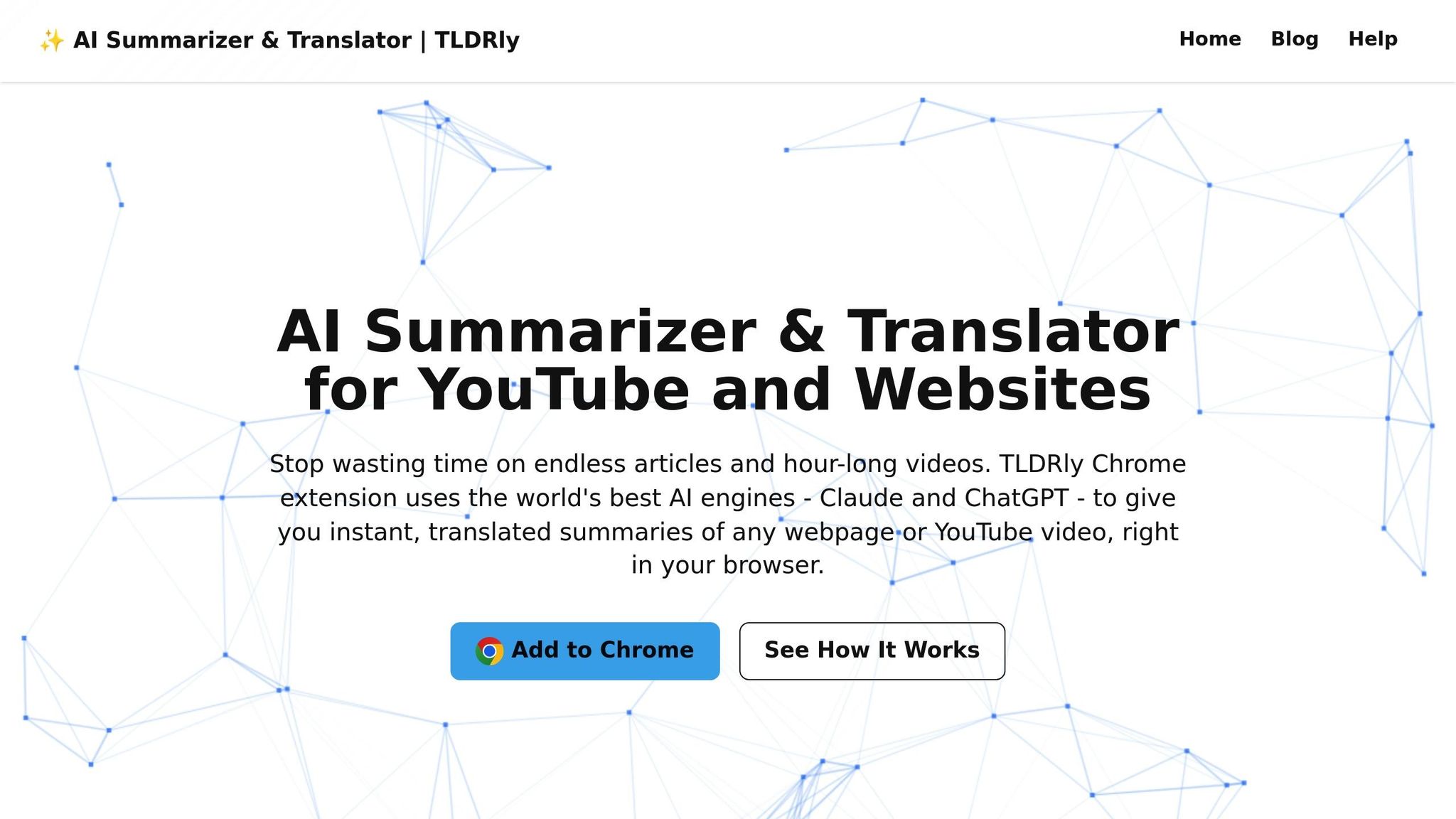
TLDRly brings enterprise-grade cross-lingual summarization to individual users. The Chrome extension uses ChatGPT and Claude to generate instant multilingual summaries for YouTube videos, articles, and web pages[2].
The user feedback tells the story:
"Honestly saves me hours every week. I can actually keep up with research papers now without drowning in the details. Wish I'd found this ages ago."[1]
For business users:
"Makes dealing with international clients so much easier. Quick summaries mean I can respond faster without stuffing around with clunky translations."[1]
The tool aggregates premium AI models that individually cost $20/month[1]. One-click summarization. Automatic translation to your preferred language. Persistent language preferences. Privacy-first architecture—no data selling, no advertising.
Rated 5/5 on the Chrome Web Store, TLDRly demonstrates that sophisticated cross-lingual AI isn't just for enterprises anymore.
The Bottom Line
Cross-lingual summarization has crossed from research curiosity to practical tool. The technology combines neural translation with intelligent compression, delivering summaries that preserve meaning while adapting to target language structure.
The shift from pipeline approaches (translate-then-summarize or vice versa) to direct multilingual models marks a genuine capability jump. End-to-end systems avoid the error propagation that plagued earlier methods.
Challenges remain. Semantic accuracy in edge cases. Idiomatic translation. Low-resource language support. But recent advances in multilingual transformers, evaluation metrics, and training techniques have made cross-lingual summarization reliable enough for production use.
What Matters
- Cross-lingual summarization eliminates the translate-then-summarize tax, delivering culturally-aware summaries in one pass
- Direct multilingual models outperform legacy pipeline approaches
- Abstractive methods produce more natural output than extractive techniques
- Real applications span business intelligence, journalism, academia, and legal work
The technology's practical impact is already measurable:
"Honestly saves me hours every week. I can actually keep up with research papers now without drowning in the details. Wish I'd found this ages ago." - Emma Johnson, PhD Student [1]
FAQs
Traditional methods hit you with a double-whammy of errors: translation mistakes compound with summarization mistakes. Multilingual AI models sidestep this entirely by generating target-language summaries directly from source text.
These models understand context and nuance across languages simultaneously. They don't lose meaning at a handoff point because there is no handoff. The result: summaries that are more accurate, more concise, and more natural-sounding than anything a pipeline approach produces.
Cultural context and idioms are genuinely hard. "Break a leg" doesn't mean what it literally says, and direct translation produces nonsense.
Modern systems attack this through contextual learning and training on diverse multilingual datasets. By seeing millions of examples where idioms appear with their intended meanings, models learn to recognize and appropriately translate figurative language. Cultural knowledge bases help too—they flag expressions that need semantic rather than literal translation.
Low-resource languages lack the training data that makes modern AI work. But speakers of these languages deserve access to global information too.
Transfer learning offers a path forward: models trained on high-resource languages learn general patterns about summarization and translation, then adapt those patterns to low-resource pairs. Data augmentation—creating synthetic training examples by translating existing content—fills some of the training gap. These techniques aren't perfect, but they're steadily improving access for speakers of underrepresented languages.