How AI Summarization Helps Multilingual Learners
Multilingual learners face a brutal double burden: they're trying to decode language and learn subject matter simultaneously. AI summarization tools cut through this by condensing dense texts into clear summaries—often with built-in translation—so students can actually focus on concepts instead of wrestling with vocabulary.
Key takeaways:
- Tools like TLDRly and ReadSpeaker summarize and translate content, slashing comprehension time significantly.
- Abstractive summarization rephrases content into simpler language—far more useful for multilingual students than extractive methods.
- Real-time features keep learners in sync with live discussions and technical materials.
- Schools using AI tools report measurable improvements for English-as-a-second-language (ESL) students.
The bottom line: AI summarization is breaking down language barriers that have blocked learners for decades.
AI Summarization Basics
What is AI Summarization?
AI summarization uses machine learning to condense lengthy text into shorter, digestible versions while preserving the essential information. Think of it as a research assistant that plows through dense papers, articles, or video transcripts and hands you the key points[7].
Modern tools like Claude and ChatGPT excel at this—producing summaries that are clear and factually grounded[1]. For multilingual learners, this is transformative. Instead of fighting through complex academic texts in a second or third language, you can quickly grasp the main ideas and decide whether the full content deserves your time.
How AI Processes Multilingual Text
AI summarization tools use language-agnostic algorithms and multilingual embeddings to identify key ideas regardless of the source language[7]. No separate programming needed for each language—the systems recognize universal concepts across linguistic boundaries.
Multilingual word embeddings are the secret sauce here. They map equivalent ideas across languages, so the system understands that "reunión" in Spanish, "meeting" in English, and "réunion" in French all point to the same concept. Transfer learning then lets the AI apply knowledge from one language to another, ensuring accurate, context-aware summaries across languages[7].
The typical workflow involves two steps: summarize first, then translate into the user's preferred language. Tools like TLDRly handle both with advanced AI engines, producing translations that actually sound natural[1].
"Not all translation is created equal. We use Claude and ChatGPT – the same AI engines that cost $20/month individually – to give you translations that actually sound natural." - TLDRly.ai[1]
Set your preferred language once, and the tool remembers it for all future summaries. No fiddling with settings every time[1][7].
Extractive vs. Abstractive Summarization
Two main approaches exist, and they serve multilingual learners very differently.
Extractive summarization pulls key sentences directly from the original text. It preserves exact wording but often keeps the complexity intact—not ideal when the original phrasing already confuses you[7].
Abstractive summarization takes a fundamentally different approach. It interprets content, rephrases it, and generates new sentences that are simpler and more concise. This method shines in multilingual contexts because the AI can adjust language complexity to match the learner's proficiency, reorganize ideas for clarity, and explain concepts using straightforward vocabulary[7]. Research confirms that abstractive summarization delivers better speed and accuracy than older fine-tuning methods[7].
TLDRly leans heavily on abstractive methods for exactly this reason[1]. The AI doesn't just copy-paste—it actually understands the material and reformulates it to be more accessible.
Breaking Language Barriers with AI Summarization
Common Challenges for Multilingual Learners
Academic content in a non-native language creates a punishing cognitive load. You're simultaneously decoding language and processing subject matter—a juggling act that drains mental energy fast[2]. Even ESL students with personalized instruction often struggle to follow spoken lessons or parse technical terminology.
Time compounds the problem. Reading academic texts in a non-native language takes dramatically longer than for native speakers. Staying current with coursework, assignments, and deadlines becomes a constant battle.
Then there's the jargon problem. Many students end up translating word by word, which shifts focus from understanding concepts to deciphering vocabulary[2]. For learners with additional challenges—hearing impairments, need for real-time classroom support—these difficulties multiply[9].
How AI Summarization Helps Multilingual Learning
AI summarization attacks these problems directly by condensing complex material into focused summaries that highlight what actually matters[4].
The killer feature for multilingual learners: combined summarization and translation. Receive summaries in your most comfortable language, absorb concepts faster, move on[4].
Here's a real example: eighth-graders were assigned an 11th-grade reading level article about the Willow project. Using Poe, the teacher adjusted content to a fifth-grade reading level. Within seconds, students had an accessible version tailored to their needs[4].
Speed matters enormously in live settings. Unlike traditional translation methods that create delays, AI summarization works in real time—students keep pace with live discussions without falling behind[9].
Beyond text, AI tools offer audio translations via text-to-speech and visual elements that support different learning preferences[8]. They create a judgment-free environment where students can revisit material, practice vocabulary, and tackle concepts at their own pace—without embarrassment[8].
"Honestly saves me hours every week. I can actually keep up with research papers now without drowning in the details." - Emma Johnson, PhD Student[1]
At Springfield Technical Community College, bilingual instructors used AI tools to translate PowerPoint slides, then refined the output with their own expertise. This hybrid approach—AI plus human refinement—proved highly effective in multilingual classrooms[2].
How to Use AI Summarization Tools
Selecting an AI Summarization Tool
Language support comes first—does the tool handle your specific languages, including less common ones like Mandarin or Arabic? Then consider summary depth: sometimes you need brief overviews, other times detailed summaries capturing nuance. Integration matters too—check compatibility with your LMS, YouTube, or research databases. For live lectures or webinars, real-time processing is non-negotiable. Finally, weigh cost against features to ensure reasonable value.
Setting Up Language Preferences and Summarization Options
Configure these upfront to save headaches later. Set primary and secondary languages so summaries generate automatically in your preferred language. Adjust summarization depth based on purpose—concise for scanning multiple sources, detailed for complex subjects. Enable text, audio, and notes features to strengthen vocabulary and pronunciation. For technical subjects, add domain-specific glossaries to improve specialized term accuracy. Fine-tune settings as you go.
Creating and Using AI Summaries
The workflow is straightforward: paste text, upload a document, or share a URL. If source content is in a different language, ensure the tool translates before summarizing. Set preferred summary length and organization. After generation, review against your learning objectives. Use summaries as study guides, flashcard material, or springboards for deeper research. Springfield Technical Community College instructors translate presentations via AI, then refine manually—blending AI speed with human expertise.
TLDRly's Features for Multilingual Learners
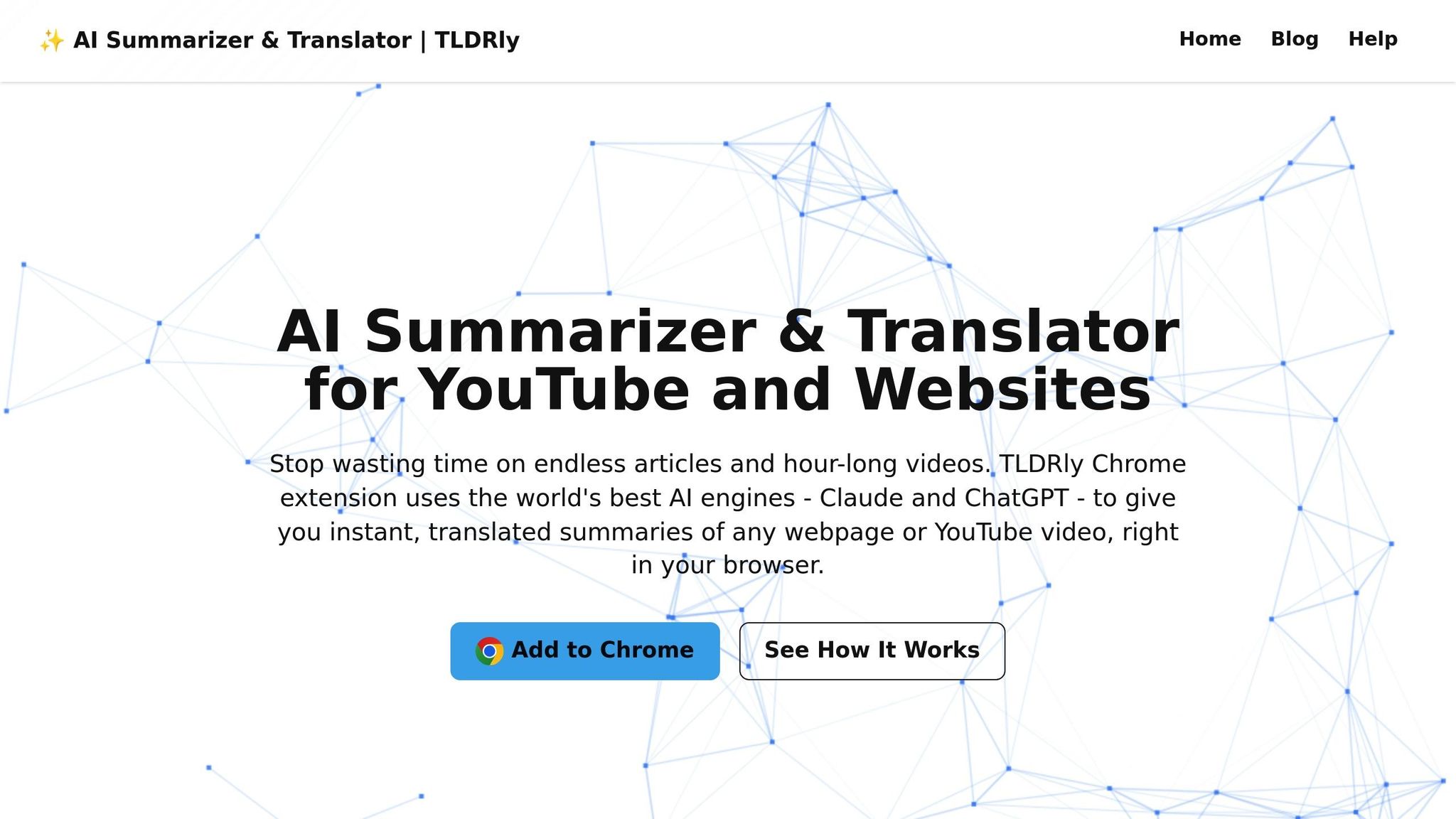
TLDRly integrates directly into Chrome—no app-switching required. It's powered by advanced AI models like ChatGPT and Claude (each costing around $20/month individually), producing natural, context-aware summaries. The instant translation feature is the standout for multilingual learners: set your language preference once, and TLDRly remembers it for everything.
"Honestly saves me hours every week. I can actually keep up with research papers now without drowning in the details." - Emma Johnson, PhD Student
The tool handles webpages, YouTube videos, or single tricky paragraphs. During live webinars, it delivers instant summaries so you stay engaged without waiting for manual translations. Your data stays private.
"Nine times out of ten the summary tells me everything I need to know - don't even bother with the full translation anymore. Absolute lifesaver when you're bouncing between countries." - James Smith, Digital Nomad
Improving Learning Outcomes with AI Summaries
Using Summaries for Study and Review
AI summaries transform how students approach dense material. For multilingual learners, summaries narrow down key concepts fast—no more sifting through lengthy texts. Time savings are real, and focus shifts to what actually matters for exams.
A smart routine: create summaries of assigned readings in your preferred language before class. Grasp main ideas ahead of time, then follow along more easily when instructors use technical terms. Combine summaries with lecture notes afterward for comprehensive study guides.
For exam prep, compile summaries of all course content one to two weeks before the test. Unclear sections in summaries signal topics needing more review. Summaries also generate practice questions efficiently, reducing test anxiety through better preparation. Research shows AI tools can provide educators with insights into student progress, enabling targeted support[3].
Adapting Summaries for Different Learning Styles
Visual learners: Convert text summaries into diagrams, concept maps, or flowcharts. Visual aids often process faster than text in a second language. Color-coding and icons enhance clarity.
Auditory learners: Use text-to-speech tools to hear summaries while following along with text. This combination improves pronunciation, builds vocabulary, and strengthens reading comprehension[2].
Kinesthetic learners: Turn summaries into flashcards, create physical models, or teach the material to someone else. Movement and interaction deepen understanding.
Many multilingual learners find blending methods—reading, listening, and creating visuals—delivers the best results. This multi-modal approach engages different senses and reinforces learning[3].
Using Summaries in Education and Group Learning
AI summaries level the playing field in group settings. When educators distribute summaries before discussions, everyone—especially multilingual learners—can understand key concepts in advance[2]. This preparation reduces anxiety and encourages active participation.
Summaries serve as shared reference points in discussions, making conversations more structured. Assigning different summary sections to small groups for analysis and presentation fosters balanced participation. Students can compare summarized content to their own interpretations, encouraging deeper engagement.
For presentations, summaries quickly surface main arguments and supporting evidence—freeing time for communication skill refinement rather than content comprehension struggles.
Collaborative projects benefit too. Team members generate summaries in preferred languages, ensuring shared understanding while accommodating varying proficiencies. Businesses using AI for multilingual workflows report up to 20% revenue increases when operating across diverse languages[7].
The key: treat summaries as foundations, not endpoints. Meaningful learning happens when students actively engage—asking questions, debating ideas, exploring topics deeper[2].
Best Practices and Common Mistakes to Avoid
When to Use Human Review
Certain scenarios demand human oversight to ensure accuracy and context:
Academic assessments: When AI summaries feed into formal evaluations, educators must verify that summaries accurately capture original material. A missed argument or oversimplified theory can mislead students[2][5].
Culturally sensitive content: Nuances, idioms, and cultural references frequently escape AI systems. Human review ensures contextual appropriateness[6].
Specialized fields: Medicine, law, and engineering require precise terminology. AI may inadvertently omit crucial details—a medical procedure summary might skip essential safety steps without expert review[5].
Multiple language conversions: Translating AI summaries into other languages can amplify errors. Review ensures intended meaning remains intact[2].
Sarcasm, humor, or implicit context: AI struggles with tone and underlying meaning. Human verification prevents misrepresentation[6].
Understanding AI Limitations
AI summarization tools face challenges that disproportionately affect multilingual learners:
Language coverage and vocabulary: AI performs better with languages having extensive training data. Mandarin or Spanish users typically get better results than Swahili or Urdu users. Specialized terminology and proper nouns can also confuse AI[2][5].
Cultural context: AI frequently misses cultural references or idioms. "It's raining cats and dogs" might translate literally, leaving non-native speakers confused[6].
Oversimplification: AI can strip important nuances from advanced topics. Philosophical arguments or scientific theories may lose depth[4].
Translation errors: AI translation features can introduce mistakes when converting summaries between languages, compounding difficulties for non-native language learners[2][6].
Keeping Context and Accuracy
Deliberate verification strategies preserve original meaning:
Compare with original source: Read summaries alongside originals to confirm key facts, arguments, and statistics are accurately represented. Check introductions and conclusions to ensure author intent is captured[2][4].
Cross-reference with multiple tools: Generate summaries from different AI platforms. Alignment on major points increases confidence; significant differences signal closer review needed[4].
Verify numbers and data: Manually confirm statistics, dates, and percentages match sources. AI can misinterpret decimal points or misattribute data[5].
Test comprehension with questions: Use AI to generate follow-up questions about summaries. If summaries fail to support detailed questions, they likely missed important details[3][4].
Back-translation for multilingual learners: Translate summaries back into English to reveal whether original meaning was preserved[2].
Customize language models: Fine-tune AI tools with subject-specific glossaries to reduce errors in specialized fields[6][9].
Monitor with feedback: Continuous evaluation using user feedback refines AI tools over time. Faculty report improved ESL student comprehension when AI tools pair with human oversight, especially for technical terminology[2].
AI summaries work best as starting points, not final products. For multilingual learners, they provide scaffolding—a foundation to grasp main ideas before engaging with original material. This approach supports understanding while encouraging active learning[2][4].
Using AI to Summarise Educational Research Papers
Conclusion
AI summarization tools are fundamentally changing multilingual learning by converting complex content into accessible summaries and eliminating language barriers that have blocked learners for decades.
The numbers back this up. Organizations using AI for multilingual workflows report up to 20% revenue increases when operating across languages, plus 60% reductions in documentation errors[7]. Springfield Technical Community College found that ESL students benefited significantly from AI tools offering captions, translations, and text-to-speech within learning systems[2].
"Honestly saves me hours every week. I can actually keep up with research papers now without drowning in the details."
– Emma Johnson, PhD Student[1]
Browser-integrated tools like TLDRly deliver instant summaries and translations for YouTube videos, articles, and web pages—no app-switching required. Multilingual learners stay focused, process information efficiently, and avoid overwhelm.
"Makes dealing with international clients so much easier. Quick summaries mean I can respond faster without stuffing around with clunky translations. An outstanding tool."
– Isabella Williams, Marketing Manager[1]
But use AI summaries wisely. They work best as study aids and starting points—not replacements for full content. Academic or culturally sensitive material requires human review. AI tools have limitations with specialized terminology, so cross-referencing remains essential.
For multilingual learners, AI summaries act as stepping stones—grasping key ideas before diving into complex topics. Whether you're a PhD student tackling dense research, a digital nomad managing cross-country work, or an ESL student navigating technical coursework, these tools smooth the learning process.
The approach that works: pair AI summaries with critical thinking, verify details for important tasks, and bring in human expertise when needed. Combining AI with traditional learning methods helps multilingual learners overcome language challenges and succeed academically.
FAQs
AI summarization tools break down complex content by delivering clear summaries and translations in learners' preferred languages. This lets students bypass language friction, save significant time, and focus on the essential information.
By converting dense material into manageable sections, these tools improve comprehension and help learners maintain focus—regardless of subject complexity.
AI summarization tools can stumble with complex ideas or culturally nuanced content. They often struggle to interpret subtle meanings, idiomatic phrases, or references lacking direct equivalents in other languages—sometimes producing overly simplified summaries that miss important context.
Cultural nuances create additional complexity. Fully grasping societal norms, values, and traditions exceeds current AI capabilities. Tools like TLDRly aim for accurate multilingual summaries, but users should review translations carefully to ensure content meets expectations and respects cultural subtleties.
AI summarization tools enable teachers to simplify complex topics into clear, accessible summaries—particularly valuable for multilingual students. Translation capabilities let students access material in their most comfortable language.
By reducing information complexity and providing multilingual support, AI tools allow students to concentrate on core concepts without feeling overwhelmed. This makes learning more approachable and engaging for students from diverse language backgrounds.